Dreaming of life on the open road? RV lifestyle budgeting can feel overwhelming at first. Many wonder how much money they’ll need each month for their mobile lifestyle.
Our research shows that full-time RVing expenses usually range from $1,600 to $5,000 monthly. This range depends on your travel style, comfort, and spending. Some save money, while others spend more on luxury.
Knowing RV living costs early helps avoid surprises. We’ve listed all the expenses you’ll face, from campsite fees to fuel. This guide helps you make a realistic monthly budget breakdown for your lifestyle.
Whether you’re starting your RV adventure or already living it, we’ll show you where your money goes each month. Let’s explore the numbers that matter for your journey.
Key Takeaways
- Monthly RV living expenses usually range from $1,600 to $5,000, based on lifestyle choices
- Campsite fees are the biggest expense, averaging $500 to $1,200 monthly
- Fuel costs vary a lot, from $250 to $700 monthly, based on travel
- Food expenses are similar to traditional living, at $400 to $800 monthly
- RV maintenance, insurance, and connectivity add to your budget
- Daily expenses can be $20 to $100, depending on campsite and activities
1. Understanding the RV Lifestyle
Before we dive into RV living expenses, let’s understand what this lifestyle means. It’s more than weekend trips or vacations. It changes how we live, work, and manage our days.
Many dream of traveling in an RV, but they don’t know the real deal. RV lifestyle fundamentals need careful planning. We must know the good and bad sides.
RV Living Basics
Starting RV living means downsizing a lot. We learn to live with less and make every item count. Sorting and deciding what to keep takes months.
Living in a small space becomes easy over time. RVs are 200-400 square feet. We must use space wisely and make areas serve many purposes.
Living on the move is a big part of RV life. We get used to new places, weather, and rules. Being adaptable is key.
Benefits of RV Living
Freedom to travel is the biggest plus for RVers. We see new views every week. This lets us follow good weather and avoid bad seasons.
“The freedom of the open road isn’t just about travel—it’s about discovering who you really are when you strip away the excess.”
Adventure is part of our daily life, not just vacations. We explore parks, find hidden spots, and meet new people. These moments make lasting memories.
Lower housing costs are possible, but it depends on how we live. Many find their RV living expenses are less than owning a house if managed right.
Common Misconceptions
Many think RV living costs less than houses. But it’s not true for everyone. Our costs change to fuel, camp fees, and maintenance.
New RVers often underestimate costs. We face regular maintenance, repairs, and high fuel costs. We need to budget and prepare financially.
Another myth is that RV living is always like a vacation. But we do daily tasks like work, laundry, and cooking. The difference is our surroundings, not needs.
Knowing these basics helps us decide if RV living fits our goals and likes. Good preparation is key for a great nomadic life.
2. Initial Costs of Buying an RV
Knowing about RV purchase expenses is key to a smart mobile lifestyle choice. The costs can vary a lot based on your choices. But, planning ahead can prevent financial surprises. We’ll look at the main costs so you can plan your RV adventure budget well.

New vs. Used RV Costs
New RVs cost a lot, from $50,000 to over $400,000 for luxury ones. Good used RVs start at $10,000 and can reach $200,000, based on age and condition.
New RVs have the latest features and warranties. But, they lose value fast, up to 20% in the first year. Used RVs are cheaper but might need repairs or upgrades right away.
“A quality used RV can save you tens of thousands while providing years of service, making it a great choice for beginners.”
Think about the total cost of owning an RV. A more expensive used RV in good shape might be cheaper than a cheaper one needing repairs.
Financing Options and Interest Rates
RV financing costs depend on your credit score, down payment, and the RV’s age. Most loans last 10 to 15 years, but can go up to 20 years for newer, pricier models.
Interest rates for RV loans are between 4% and 15%, based on your credit. Getting pre-approved helps you know your budget before buying.
Compare rates with different lenders, like banks, credit unions, and RV dealers. Credit unions often have the best rates for members. Longer loans mean lower monthly payments but more interest over time.
Insurance Costs
RV insurance is a big ongoing cost that many new owners don’t think about. Full-time RV insurance costs about $800 to $1,000 or more a year, based on your RV’s value and coverage needs.
Standard RV insurance won’t cover full-time living. You need special coverage for liability, personal items, and emergency lodging if your RV needs repairs.
The total RV lifestyle costs for insurance also include roadside help, which is key for mobile living. Many policies offer this as an add-on. But, services like Good Sam or AAA provide full coverage options.
Get insurance quotes before buying your RV to understand this ongoing cost. Shopping for insurance early helps you budget well and avoid surprises when you start your RV journey.
3. Monthly RV Payment Considerations
Plan your monthly RV payments carefully. This ensures you have enough money for other RV costs. Your RV loan payment will likely be a big part of your RV living budget breakdown. Try to keep this payment under 20% of your monthly budget to stay flexible.
Smart financing choices today help your financial comfort on the road. The loan terms you pick affect your monthly cash flow and long-term finances.
Typical Loan Terms
RV loans usually last from 10 to 20 years. This gives you options for your payments. Longer loans mean smaller monthly RV payments, but you’ll pay more in interest.
Here’s how different loan terms affect your payments:
- 10-year loans: Higher monthly payments but save on interest
- 15-year loans: A good balance between payment size and total cost
- 20-year loans: Smallest monthly payments but highest interest costs
Choosing shorter terms can save you thousands. The goal is to find a term that fits your RV living budget breakdown without overextending.
Impact of Down Payments
Your down payment is key in RV loan management. A bigger down payment lowers your monthly payments and protects you from owing more than your RV’s value.
RVs lose value quickly, mainly in the first years. A big down payment helps cover this loss and keeps you in positive equity.
Consider these down payment benefits:
- Lower monthly payments free up budget for other RV expenses
- Less interest over the loan’s life
- Better loan terms and rates from lenders
- Protection against quick RV depreciation
Managing Monthly Payments
Good RV loan management is more than just on-time payments. Look for ways to pay less interest and build equity faster.
Make extra principal payments when you can. Even an extra $50 a month can cut years off your loan and save thousands in interest.
Set up automatic payments to avoid late fees and get interest rate discounts. Many lenders offer a 0.25% rate cut for automatic payments.
Remember, your RV payment is just one part of your finances. Make sure to budget for fuel, maintenance, campground fees, and unexpected repairs that come with RV living.
4. Fuel Costs for RV Living
Fuel costs are a big part of full-time RV living costs. RVers spend $250 to $700 a month on fuel, with an average of $500. These costs change based on how much you travel, your RV’s size, and gas prices.
Knowing your RV fuel expenses helps you plan your budget better. Fuel costs are not fixed like insurance or loan payments. They change based on your travel and lifestyle.
Average Mileage and Fuel Efficiency
Your RV’s fuel efficiency affects your budget. Big Class A motorhomes get 6-8 MPG. Smaller travel trailers get 10-12 MPG when towed right. Fifth wheels get 8-10 MPG.
Track your mileage to get accurate fuel numbers. Your driving, terrain, and RV care affect these numbers. Mountain driving can cut efficiency by 20-30%. Flat roads help you get better gas mileage.
Class B camper vans are the most fuel-efficient, getting 15-20 MPG. But they have less space. You must weigh fuel savings against comfort needs.
Budgeting for Long Trips
Good travel budget planning means figuring out fuel costs before you go. Use current gas prices and add 20% for price changes and detours. This helps avoid overspending when fuel prices go up or you take different routes.
For long trips, estimate your total miles and divide by your RV’s MPG. Then, multiply by fuel prices at your destination. Different places have different fuel costs. The West Coast often has higher prices than the Midwest.
“The key to managing RV fuel expenses is planning your routes carefully and building flexibility into your budget for unexpected costs.”
Seasonal price changes affect fuel costs. Summer prices are usually higher, while winter prices are lower. Try to travel during shoulder seasons for better prices.
Tips for Reducing Fuel Costs
Smart driving habits can cut your RV fuel expenses. Driving at 55-60 MPH instead of 70+ MPH can save 15-25% on fuel. It takes longer to get there, but you save money over time.
Staying longer in places saves fuel and reduces RV wear. Instead of moving every few days, stay a week or more. This saves fuel and lets you explore more.
Keeping your RV in good shape also saves fuel. Maintaining correct tire pressure can improve fuel economy by 3-5%. Regular air filter changes, proper wheel alignment, and avoiding extra weight also help.
Planning your route wisely saves fuel. Avoiding mountains and heavy traffic areas saves fuel. Use GPS apps to find the best routes.
Fuel discount programs can save a lot of money. Good Sam and TSD Fuel Card offer discounts at truck stops. These programs can pay for themselves quickly.
Think about your RV’s aerodynamics when driving. Remove roof accessories, keep windows closed at high speeds, and drive steadily. These small changes can improve fuel efficiency and lower full-time RV living costs.
5. RV Maintenance and Repairs
RV maintenance costs are a big part of living on the road. Many new RVers don’t plan for these costs well. This can lead to financial stress and unexpected expenses. It’s wise to set aside a big part of your RV living monthly expenses for maintenance and repairs.
Knowing what maintenance your RV needs helps you budget better. Regular care stops big problems and makes your RV last longer.
Routine Maintenance Expenses
Regular maintenance is key to your repair budgeting plan. These costs usually add up to $200-300 monthly over time.
Important tasks include oil changes, tire checks, and brake inspections. You’ll also need to check the roof, replace air filters, and service appliances.
Don’t forget about generator upkeep. This includes oil changes and air filter cleaning. It keeps your RV running smoothly on trips.
Unexpected Repair Costs
Unexpected repairs are the biggest challenge in RV maintenance costs. Repair bills can range from a few hundred to several thousand dollars.
Common surprises include roof leaks, transmission issues, and appliance failures. Dealerships charge $200 per hour, while mobile services cost $150-200 per hour.
Big repairs like engine work or roof replacements can cost $3,000-10,000. Having an emergency fund of at least $3,000-5,000 helps cover these costs.
Finding Affordable Services
Finding cheap repair services is key to saving money. Costs vary a lot between providers and places.
Independent mechanics usually charge less than dealerships. Mobile services are convenient but cost more. Building relationships with mechanics in places you visit often saves money.
Learning to fix simple problems yourself can save a lot. Tasks like changing air filters and checking fluids can save hundreds.
RV clubs and online forums are great for finding affordable services. Experienced RVers share their favorite mechanics and service tips.
6. Campground Fees and Lodging
Choosing the right campground is key to your budget. It can save you $500 or cost $1,200 a month. Knowing your options helps you stick to your RV life budget.
Prices vary by location. Places with lots of tourists or by the coast cost more. Try to travel during shoulder seasons to save money.
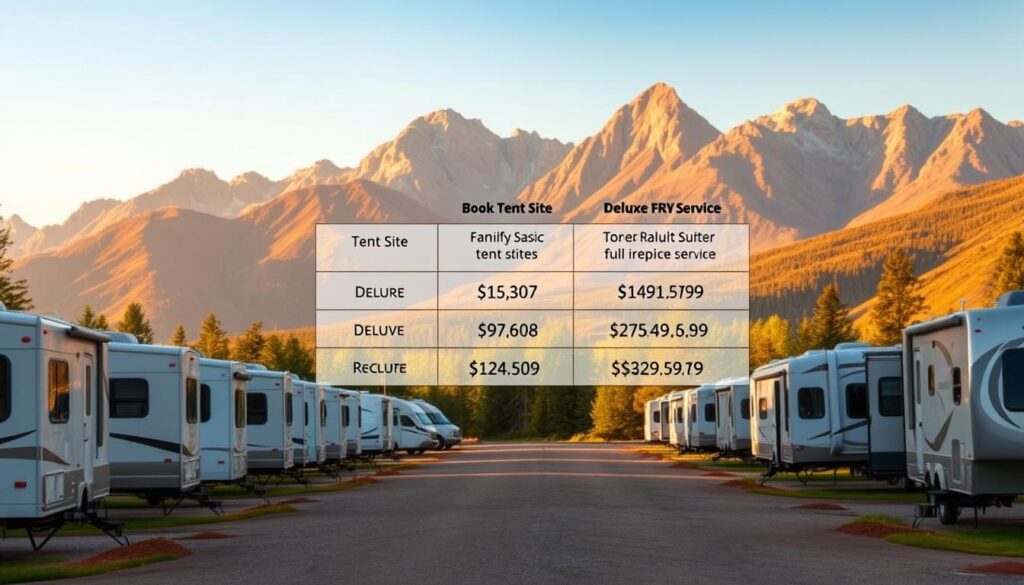
Different Campground Options
There are many types of campgrounds for every budget. Each has its own costs and benefits.
State and national parks are the cheapest. They cost $20-40 a night. They have basic things like restrooms and showers. But, spots fill up fast, so book early.
Private RV parks offer more. They cost $30-80 a night. You get things like Wi-Fi and laundry. The price is higher because of these extras.
Luxury RV resorts are the most expensive. They cost $50-150+ a night. They have fancy things like pools and spas. They’re pricey but feel like a vacation.
Membership campgrounds need a big upfront payment. But, they can save you money in the long run. Places like Thousand Trails can cut your costs a lot.
What You’ll Pay Each Night
Knowing nightly rates helps plan your RV life budget. Prices change based on where you are, the season, and what’s included.
Basic sites cost $14-25 a night. They have a spot to park and shared restrooms. Full hookup sites cost $25-50 a night. They have water, electric, and sewer.
Places near popular spots cost more. You might pay $60-100+ a night in peak season. This includes beach areas and national parks.
Prices change with the seasons. Summer can double or triple prices. We’ve seen prices go from $40 in winter to $120 in July.
| Campground Type | Nightly Rate Range | Monthly Estimate | Key Features |
|---|---|---|---|
| State/National Parks | $20-40 | $600-1,200 | Basic amenities, natural settings |
| Private RV Parks | $30-80 | $900-2,400 | Full hookups, amenities, convenience |
| Luxury Resorts | $50-150+ | $1,500-4,500+ | Premium amenities, resort services |
| Membership Parks | $15-35 | $450-1,050 | Reduced rates after membership fee |
Getting Better Deals for Long Stays
Getting discounts for long stays is key for full-time RVers. Most places offer big savings for longer stays. You just need to ask the right way.
Weekly rates are the first discount tier. Many places offer seven nights for six, saving you 15%. This is great for exploring an area for a week.
Monthly rates are the best deal for long stays. We’ve gotten discounts of 20-40% off nightly rates for monthly stays. Some places offer even better deals for longer periods.
Talking directly to campgrounds gets you better deals than online booking. Call them to discuss long-term rates, best during off-peak seasons. Building a relationship with the manager can get you better prices.
Off-season negotiations are the best time to save. Campgrounds with low occupancy are more willing to lower prices. We’ve gotten monthly rates as low as $300-400 during slow times.
Consider being a campground host or work camper. Many places offer free or discounted sites for part-time work. This can almost eliminate your accommodation costs from your RV life budget.
Membership programs and loyalty clubs can also save you money. Many chains offer discounts or points for frequent visitors. These can lower your campground costs in the future.
7. Utilities and Living Expenses
Living in an RV has its own budgeting challenges. Your RV utility expenses change a lot. This depends on whether you stay at full-hookup campgrounds or go boondocking. We need to know these costs to make a good budget.
RV living is flexible. But, it also means variable utility costs. We must plan and make smart energy choices.
Electricity and Water Costs
Electricity costs change based on your camping style and location. At full-hookup campgrounds, electricity is often included. But, some places charge $100 to $300 monthly for it.
Electric bills vary by state. They can be $77 to $90 monthly for RVs. But, prices change with energy costs and the season.
Boondocking is different. We use our RV’s battery, solar panels, or generators. Solar generators can cut electricity costs by up to 40%. They’re a good choice for boondockers.
Water costs also change. Campgrounds charge differently for water. Municipal campgrounds usually have the lowest prices.
Internet and Cell Service Expenses
Good internet is key for RVers, like remote workers. Camper van living costs include the cost of staying connected.
Internet and cell service costs are $50 to $150 monthly. This covers data plans, satellite internet, or mobile hotspots.
It’s smart to have more than one way to stay connected. Using both cellular data and satellite internet is best. This way, you have a backup in remote areas.
Propane and Heating Costs
Propane is key for RV systems like stoves, water heaters, furnaces, and fridges off-grid. Costs are $50 to $100 monthly. They change with the season and heating needs.
Winter increases propane use for heating. Budget more for cold months. Also, choose energy-efficient appliances to save.
Managing propane well means checking tanks, cooking smart, and picking campsites. Solar power and energy-efficient appliances help save money. They also let you go further off-grid.
8. Food and Grocery Budgeting
Managing your grocery budgeting on the road needs smart planning and flexibility. Most RVers find that RV food costs are $400 to $800 a month. This is often 20-25% more than what they spent at home.
This increase comes from limited storage, different prices in areas, and the urge to eat out more.
We face special challenges when budgeting for food on the road. Limited refrigerator space means we can’t stock up on perishables like we used to. Prices can also change a lot when we enter expensive tourist areas or remote places with few shops.

Meal Planning for RV Living
Good meal planning is key to controlling RV food costs. We suggest planning meals around ingredients that can be used in many ways. For example, a whole chicken can be dinner one night, soup the next day, and sandwich meat for lunch.
Choose one-pot meals to save on cleanup and use your small kitchen well. Dishes like chili, stir-fries, and pasta are great for RV kitchens. Batch cooking lets us make more when we have time and energy.
Keep track of what you have in your pantry and fridge. This stops you from buying the same things twice and helps you use up ingredients before they go bad. Many RVers use apps on their phones to keep track of their food and meal plans.
Finding Affordable Grocery Stores
Finding cheap stores is a constant search that affects our grocery budgeting success. Stores like Walmart, Aldi, and Costco have the same prices everywhere, making them good choices for RVers.
Local stores in rural areas often charge more because there’s less competition. Use apps like GasBuddy or ask other RVers online to find good grocery stores before you get there.
Buy non-perishables in bulk when you find great deals. Things like canned goods, pasta, rice, and cleaning supplies don’t need fridge space and can save money over time. Always check for discount stores like Dollar General or Family Dollar when you’re in new areas.
| Store Type | Average Savings | Best For | RV Accessibility |
|---|---|---|---|
| Walmart Supercenter | 15-20% | One-stop shopping | Excellent |
| Aldi | 25-30% | Basic groceries | Good |
| Costco/Sam’s Club | 20-25% | Bulk non-perishables | Excellent |
| Local Markets | Variable | Fresh produce | Variable |
Cooking Tips for a Small Kitchen
To make the most of your small RV kitchen, choose smart appliances and cooking methods. Get multi-purpose appliances like pressure cookers or air fryers. These save space and open up more cooking options.
Outdoor cooking is great for keeping your RV cool in warm weather. Grilling, camping stoves, and outdoor burners give you more space to cook and use less propane inside your RV. Many RVers prefer cooking outside to cooking inside.
Make big batches of food when you can to save time and effort. Cook extra food for leftovers or freeze parts for quick meals later. This way, you save time, propane, and cleaning up.
These RVing budget tips for food can really cut down your monthly costs. RVers who plan meals well and shop smart can get their food costs back to what they were before RVing. It’s all about adapting to the special needs and chances of life on the road.
9. Recreation and Entertainment Costs
RV entertainment costs make RV living special. They are the fun parts of the journey. Most RVers spend $100 to $200 a month on these activities.
RV living means exploring new places and making memories. Your budget should match your interests and travel style. Adventure-focused travelers might spend more than those who like to save.
Planning Your Adventure Fund
Adventure budgeting needs planning to enjoy without spending too much. First, think about what you like to do. Things like national park fees and rentals can add up fast.
Set aside $100 a month for fun activities. This covers most attraction fees and some rentals. If you love active adventures, plan to spend $200 or more on things like zip-lining.
Remember, your budget can change with the seasons. Summer might be pricier due to more tourists. Winter has its own costs for fun activities.
Discovering Free and Affordable Fun
Smart RVers find joy in free and cheap activities. Hiking, scenic drives, and beaches are great without spending much.
Many parks offer free programs and activities. Local events and libraries also have free stuff.
Visitor centers and tourism boards help save money. They give out coupons and tips for cheap attractions. Many cities offer free walking tours.
Maximizing Savings Through Memberships
RV club memberships can save a lot on fun activities. Clubs like Good Sam and Passport America offer big discounts.
Good Sam gives discounts at many campgrounds and on services. The annual fee is worth it for the savings. Passport America cuts costs by 50% at many campgrounds.
Harvest Hosts offers free stays at unique places like wineries. Members get to enjoy tours and tastings.
Joining different clubs can save even more. Each membership offers unique benefits. Find the ones that fit your travel style best.
Annual passes for national parks are a good deal for frequent visitors. The America the Beautiful pass is $80 for over 2,000 sites. State park passes are also a good value for local trips.
10. Assessing the Total Monthly RV Budget
To make a solid financial plan, you need to gather all costs we’ve talked about. Your RV budget should cover RV payments, insurance, fuel, and maintenance. It should also include costs for campgrounds, utilities, food, and fun.
Creating a Comprehensive Budget
People who live in RVs spend $2,000-3,000 a month on average. Those who want more comfort might spend $3,000-5,000+ monthly. Start with a safe estimate and add 10-15% for surprises. Your budget should match your travel style and what you like.
Tracking Expenses Effectively
Keeping track of your spending is key to RV living. Use apps like Mint or YNAB to watch your spending. Or, try a simple spreadsheet for basic tracking. Track your spending for a year to see real costs and find ways to save.
Adjusting Your Budget for Changing Needs
RV costs change with travel speed, seasons, and equipment wear. Check your budget every quarter and keep an emergency fund for 3-6 months. Being flexible with your budget makes your RV trip more fun and keeps your finances in check.