Imagine you’re driving down a beautiful road in your RV. Then, you hear a scary sound. Your heart drops, knowing your RV needs help right away. We’ve all been there, and it feels really tough.
The bright side is that being ready can turn a bad situation into a small problem. Most people who travel a lot say breakdowns are just part of the fun. What’s key is being ready to handle them.
This guide will teach you important things and useful tips. We’ll share methods that have helped many people deal with emergencies on the road. You’ll learn how to prevent problems and what to do in an emergency.
Whether you travel for the weekend or live on the road, these RV safety tips will help you relax. Let’s learn the important skills every traveler needs before they hit the road.
Key Takeaways
- Stay calm and prioritize safety when experiencing mechanical issues on the road
- Proper preparation and maintenance can prevent most common breakdowns
- Keep essential tools, spare parts, and emergency supplies readily accessible
- Know your insurance coverage and roadside assistance options before traveling
- Develop multiple backup plans for different breakdown scenarios
- Learn basic troubleshooting skills to diagnose common problems quickly
Understanding Common RV Breakdowns
RV breakdowns fall into three main categories. Knowing these helps us prepare and troubleshoot. Understanding common RV issues helps us respond quickly and safely.
Breakdowns often happen at the worst times. They can occur during peak travel seasons or in remote areas. But, most issues are predictable and preventable with regular maintenance.
Engine Issues
Engine problems are the most serious. They often happen when our RV works hard, like on steep hills or in bad weather.
Overheating is a top engine failure. It happens when our RV can’t cool down properly. Low coolant, clogged radiators, or failing pumps can leave us stranded.
Other engine issues include:
- Low oil pressure from not enough fluid
- Fuel system problems in older RVs
- Belt failures that affect many systems
- Transmission overheating on long climbs
Electrical Failures
Electrical problems can quickly ruin a trip. They often leave us without power for lights, water pumps, or slide-outs.
Dead batteries are the most common electrical failure. RVs have harder electrical systems than cars. When batteries fail, we lose power for starting and house use.
Common electrical issues include:
- Corroded battery terminals reducing power flow
- Blown fuses from overloaded circuits
- Faulty wiring connections that create intermittent problems
- Inverter failures that cut AC power
An effective RV troubleshooting guide starts with checking electrical connections. Loose wires cause many problems.
Tire Problems
Tire failures are the most dangerous. RVs carry heavy loads and travel long distances, stressing tires. Blowouts and pressure loss are common.
Tire blowouts can cause loss of vehicle control. They often result from underinflation, overloading, or old age. Hot pavement and high speeds increase the risk.
Key tire-related breakdown causes include:
- Incorrect tire pressure leading to sidewall damage
- Overweight loads exceeding tire capacity
- Old tires with invisible internal damage
- Road hazards like sharp debris or potholes
Knowing these common RV breakdowns helps us prepare and recognize warning signs. This way, we can avoid major failures.
Preparing Your RV for the Road
Getting ready for a trip can make all the difference. Proper preparation is your best defense against breakdowns. A good check-up before you leave can save you from big repairs and dangers on the road.
There are three main steps to smart preparation. First, keep up with regular maintenance. Second, have the right tools ready. And third, stock up on emergency supplies. Each step is key to safe and fun travels.
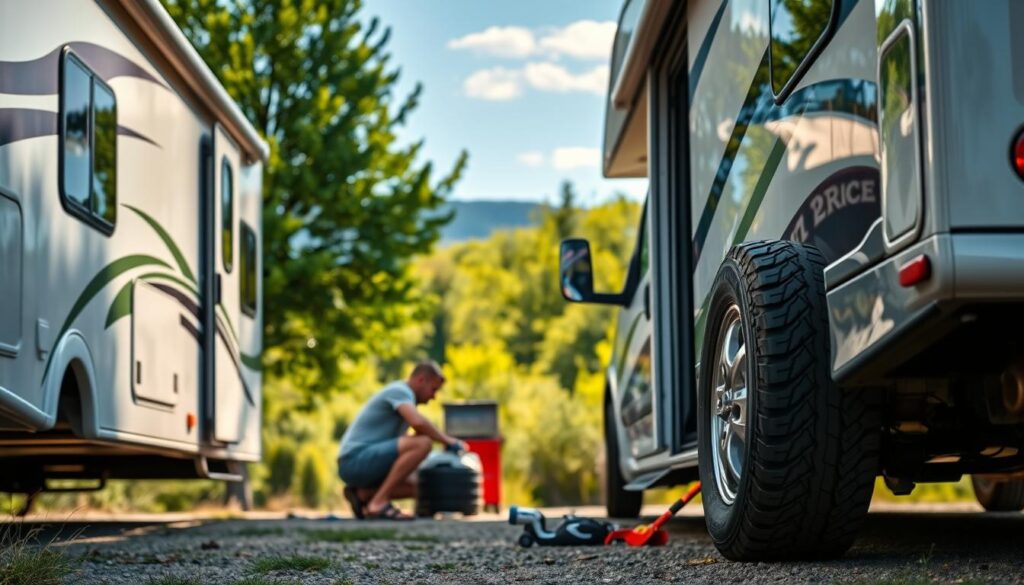
Routine Maintenance Tips
Our RV maintenance tips start with checking fluids. Make sure engine oil, coolant, brake fluid, transmission fluid, and power steering fluid are at the right levels. Low fluids can damage your engine or cause brake failure.
Testing your batteries is also important. Both engine and coach batteries need to be charged right. Use a multimeter to check voltage and clean battery terminals from corrosion.
Look for leaks on your roof, windows, and seals. Water damage can be costly and not covered by insurance. A quick visual check can save you thousands.
Tires need special care before you hit the road. Check pressure, tread depth, and look for wear or damage. Good tire care prevents blowouts and saves fuel.
Essential Tools to Bring
Every RV should have a good tool kit for quick fixes. Include adjustable wrenches, screwdrivers, and electrical tape. These tools can fix many common problems.
For modern RVs, electrical tools are a must. A basic multimeter helps with electrical issues. Spare fuses and connectors can fix problems without waiting for help.
Here are more tools for roadside repairs:
- Socket wrench set for various bolt sizes
- Wire strippers and electrical connectors for wiring repairs
- Duct tape and zip ties for temporary fixes
- Tire pressure gauge and portable air compressor
- Basic plumbing supplies for water system issues
Emergency Supplies Checklist
Your RV maintenance checklist should include emergency supplies. First-aid kits should be easy to find. Include bandages, antiseptic, and any needed medications.
Keep extra engine fluids for safe travel. Store spare oil, coolant, and brake fluid in sealed containers. These can prevent engine damage if you leak while driving.
Safety gear is vital for roadside stops. Use emergency flares or reflective triangles to warn traffic. Proper warning devices prevent accidents.
Water storage is key for long breakdowns. Carry enough water for 24-48 hours. Include water purification tablets for questionable water sources.
Don’t forget these important items in your emergency kit:
- Flashlights with extra batteries for nighttime repairs
- Emergency food that doesn’t need cooking
- Warm blankets for cold weather
- Cell phone chargers and backup power sources
- Cash for emergency services or towing
This approach prevents many breakdowns and prepares you for minor issues. Proper preparation gives you confidence and peace of mind on every trip.
What to Do When a Breakdown Occurs
Nothing ruins a road trip like realizing your RV needs emergency RV repairs. That sinking feeling when your engine makes strange noises or your electrical system fails is tough. Staying calm and following RV safety tips is key to handling these situations.
How you react in the first few minutes is critical. Have a plan ready before you start your trip. This helps you stay focused when stress kicks in.
Staying Calm and Assessing the Situation
When you notice something’s wrong, focus on breathing. Try the four-second technique: breathe in for four, hold for four, then exhale for four. This reduces stress and helps you think clearer.
While breathing, start your assessment. Listen for odd sounds, check your dashboard lights, and note any changes in how your RV drives. Most breakdowns give warning signs before they fail completely.
Avoid making quick decisions or trying emergency RV repairs when panicked. Take a moment to calm down. Your safety and that of your passengers depend on making smart choices.
Safety First: Warning Devices
Move your RV as far off the road as you can. Aim for the shoulder, rest area, or parking lot if safe. Even a little distance can make a big difference.
After stopping, use warning devices. Place safety cones, flares, or lights at least 100 feet behind your vehicle. This gives other drivers time to see you and change lanes safely. Keep these devices in your emergency kit.
If you can’t move your RV, don’t stay inside. Get out safely and move to a secure spot. Wear high-visibility safety vests if you have them. They make you more visible to other drivers and emergency responders.
These RV safety tips are not just suggestions. They are proven ways to prevent accidents. Your visibility and early warning to other drivers can save lives.
Diagnostic Steps to Identify the Problem
Fixing your RV starts with finding the problem first. Rushing into repairs can waste time and money. We use a systematic process to find the exact issue before fixing anything.
Begin with a detailed look at your RV. Look for leaks, strange sounds, or dashboard lights. Check for damage, loose parts, or wear that might cause trouble.
Listen carefully to your RV. Strange noises can tell us a lot about the problem. Take photos of what you see. This helps when talking to repair techs.
Using Diagnostic Tools
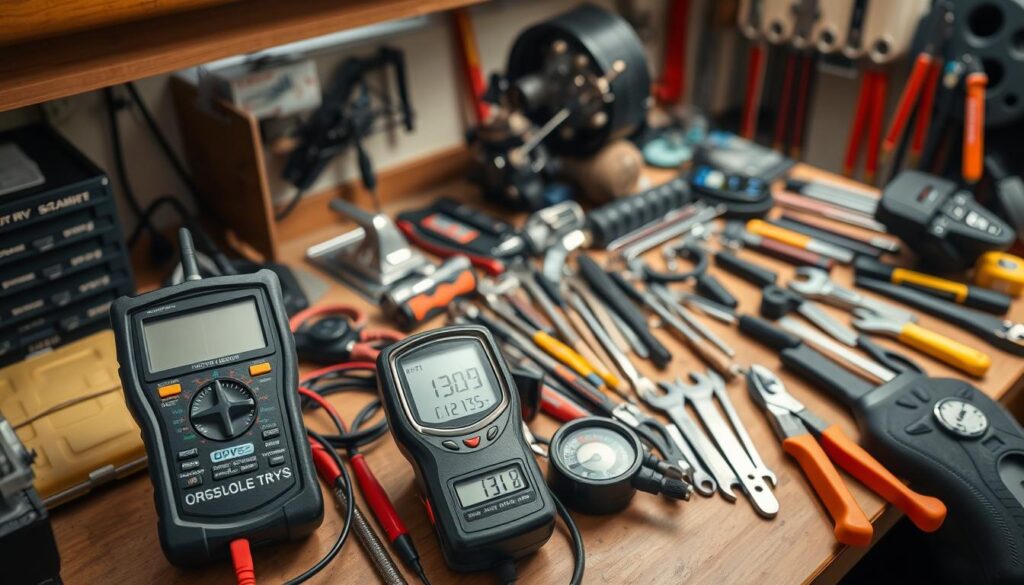
The right RV repair tools are key for accurate diagnosis. Carry a basic toolkit with essential tools. A multimeter tests electrical systems, and an OBD-II scanner reads engine error codes.
Simple tools are also important. A tire pressure gauge and a flashlight are useful. They don’t take up much space but are very helpful.
Digital tools can also help. Modern RVs have diagnostic systems that show error codes. Learning to read these codes helps us know what needs fixing.
What to Check First: Quick Assessments
Our guide starts with common problems. Check engine fluids first – oil, coolant, and brake fluid. For electrical issues, test the battery and check connections.
Tire problems need quick attention for safety. Check pressure, look for damage, and examine tread wear. These checks often find the problem quickly.
Think about recent changes or maintenance. Did the problem start after filling up or recent repairs? Connecting symptoms to recent events helps us find the cause fast.
When to Call for Professional Help
Sometimes, the best choice is to call experts in an RV emergency. It’s hard to know when to fix things yourself or call a pro. But making safe choices protects you and your RV.
Getting help isn’t just for big fixes. A pro can solve problems fast that might take you hours. This means you can get back on the road quickly and safely.
Signs It’s Time to Get Assistance
Some signs mean you should immediately call for help instead of trying to fix it yourself. Engine overheating is a big warning. Driving with an overheated engine can cost thousands of dollars.
Brake system failures need quick help. Never drive an RV with bad brakes. Your safety and others depend on working brakes.
Electrical fires or smells mean you need to act fast. Turn off your RV’s electrical systems and call for help right away. These situations can get worse fast and are very dangerous.
Big fluid leaks, like transmission or coolant, mean you need a pro. Seeing a lot of fluid under your RV means it’s a big problem.
Choosing a Roadside Assistance Service
Getting roadside assistance for RV needs careful thought. Regular towing services can’t handle RVs. This can cause delays and extra costs.
Find services that know RVs and are available 24/7. They should cover your travel areas well. Rural areas need services with a wide network.
Many RV makers and warranty companies offer roadside help. Check with your RV dealer for options. These programs know your RV model well.
Look for services that offer:
- Heavy-duty towing for big RVs
- Mobile mechanic for repairs on-site
- Trip interruption coverage for hotel costs
- Fuel delivery and lockout help
Extended warranties and manufacturer help can be very useful. They offer repair coverage and emergency roadside services. This gives you full protection on the road.
Essential RV Repair Skills for Breakdowns
Learning to fix your RV gives you the courage to go on adventures. When you’re far from help, knowing how to fix things can save your trip. DIY RV repairs save money and make you feel safe on the road.
Start by learning about your RV’s systems. Most problems are easy to fix. Know what you can do yourself and what needs a pro.
Basic Repairs You Should Know
Every RV owner should know a few basic fixes. Fuse replacement is key because electrical issues often come from blown fuses. Keep spare fuses handy and learn which ones fit each circuit.
Water leaks need quick action to avoid big damage. Use temporary sealants to hold things together until you can get to a repair shop. Seal around windows, vents, and roof seams where leaks happen.
Loose connections are common in RVs. Regularly tighten battery terminals, water pump connections, and propane fittings. A simple wrench set can fix most issues you’ll face.
Tire Changing Fundamentals
Tire failures are a big problem for RVs. Practice changing your RV’s tires at home before you hit the road. This gets you used to your RV’s specific tools.
Always have a spare tire ready and check it every month. RV tires need more air than car tires, so get a good pressure gauge. Use a jack on solid ground and engage the parking brake before lifting.
“The best time to learn tire changing is in your driveway, not on a busy highway at midnight.”
Fixing Minor Electrical Issues
Electrical problems can leave you stranded fast. But many issues are easy to fix. A basic multimeter helps find voltage problems in your RV’s systems. First, check the battery voltage, as low power can cause many failures.
Clean corroded battery terminals with baking soda and water. Corrosion blocks electrical flow and can seem like bigger problems. If cleaning doesn’t work, replace the terminals.
Know your RV’s electrical panel. Label each breaker and fuse for quick finds in emergencies. This helps you troubleshoot faster when systems fail.
| Repair Type | Difficulty Level | Time Required | Essential Tools |
|---|---|---|---|
| Fuse Replacement | Easy | 5 minutes | Spare fuses, needle-nose pliers |
| Tire Change | Moderate | 30-45 minutes | Jack, lug wrench, spare tire |
| Battery Terminal Cleaning | Easy | 15 minutes | Wire brush, baking soda, wrench set |
| Water Leak Sealing | Easy | 10-20 minutes | Sealant, putty knife, cleaning cloth |
Remember, DIY RV repairs are only for when you’re sure and safe. If you’re not sure, call a pro. Your safety is more important than fixing things fast.
DIY Repairs on the Road
Emergency RV repairs don’t always need a mechanic. With the right tools and knowledge, we can fix many problems ourselves. Knowing our RV’s systems and being ready to solve problems helps a lot.
When we’re prepared, small breakdowns don’t ruin our trip. They become challenges we can handle.
Road emergencies test our problem-solving skills. But with the right prep and approach, we can find quick fixes. These get us to help safely.
Understanding Your RV’s Layout
Before we hit the road, we should know our RV’s parts and where they are. This saves time when we have a breakdown. We need to find the electrical panel, water pump, propane tanks, generator, and access panels.
Creating a diagram or taking photos of these spots helps in emergencies. Quick reference materials reduce stress and guesswork.
- Main electrical panel and circuit breakers
- Water pump and plumbing connections
- Propane tank locations and shutoff valves
- Generator access and fuel connections
- Slide-out mechanisms and controls
Knowing how our RV’s systems work together is key. The electrical system powers the water pump, and propane feeds the fridge and furnace. This helps us fix problems better.
Temporary Fixes Until You Reach a Shop
Emergency RV repairs often need quick fixes using basic stuff. These aren’t permanent but help us keep moving safely. Always plan to get to a service center soon for real repairs.
Common fixes include roof leaks, loose electrical connections, and coolant leaks. Each needs a different fix, but the goal is the same: get to help safely.
| Problem Type | Temporary Solution | Required Materials | Safety Notes |
|---|---|---|---|
| Minor Roof Leak | Duct tape and plastic sheeting | Heavy-duty tape, plastic sheet, cleaning cloth | Ensure surface is clean and dry |
| Loose Electrical Connection | Wire nuts and electrical tape | Wire nuts, electrical tape, wire strippers | Turn off power before working |
| Small Coolant Leak | Hose clamps and rubber patches | Hose clamps, rubber patch, sealant | Allow engine to cool completely |
| Broken Cabinet Door | Zip ties or duct tape | Heavy-duty zip ties, duct tape | Secure loose items inside |
Our repair kit should have duct tape, zip ties, electrical tape, wire nuts, hose clamps, and sealant. These items can fix many common problems on the road.
Remember, temporary means temporary. These fixes are just to get us moving safely. We should fix the real problem as soon as we can.
Finding the Nearest RV Service Center
Finding good RV service centers can be tough, but it’s easier with the right tools. It’s hard to find reliable repair services when you’re far from home. Luckily, technology and community help have made this easier.
Knowing where to find service centers before you travel can save time. Make a list of places to go for help before you leave.
Apps and Resources for Locating Help
Smartphone apps have changed how we find RV services. RV Life gives you info on service centers, parts stores, and emergency services. It also has user reviews and contact info for quick choices.
Campendium is another great tool for finding RV services. It has maps and filters to help you find what you need. iExit helps with highway exit info, including RV services near major highways.
Joining RV forums and social media groups is also helpful. These groups share RV maintenance tips and service center recommendations.
- RV Life app for service listings
- Campendium for maps and reviews
- iExit for highway service info
- RV forums and Facebook groups for tips
- Manufacturer websites for authorized service centers
What to Look for in a Service Center
Not all repair shops can handle RVs. Look for places that say they work on RVs and have enough room for your RV. Proper equipment and skilled technicians are key for good repairs.
Online reviews from RV owners can help you choose. Call ahead to talk about your problem and make sure they have the right RV repair tools and know-how.
Here are important things to look for in a service center:
- RV-specific experience and expertise
- Enough space and the right equipment
- Good reviews from RV owners
- Parts and supplier connections
- Fair prices and clear estimates
Mobile RV repair services are now common in popular spots. They can come to you, often faster than regular shops.
Don’t forget about manufacturer-authorized service centers. They have direct access to parts and tech support for quick repairs. Keep a list of these centers as you plan your trip.
Preventing Future Breakdowns
Prevention is better than fixing things after they break. We’ll show you how to keep your RV running smoothly. Smart maintenance practices make your RV reliable and cut down on emergencies. A good RV maintenance checklist means worry-free adventures and protects your investment.
Regular care saves money and stress. It also helps find small problems before they become big ones on the road.
Monthly Care Routines
Check your RV monthly, even when it’s stored. Fluid levels are key. Make sure to check engine oil, coolant, brake fluid, and transmission fluid often.
Battery care prevents many electrical issues. Test your battery voltage and clean terminals every month. Corroded connections cause more problems than old batteries.
Tire pressure changes with temperature and time. Check all tires, including the spare, every month. Look for uneven wear that means alignment problems.
“An ounce of prevention is worth a pound of cure, when you’re far from home.”
These RV maintenance tips include using your generator monthly. Run it for at least two hours under load. This keeps parts lubricated and fuel fresh.
Getting Ready for Each Season
Seasonal prep protects your RV from weather damage. Winter prep means draining water systems and adding antifreeze to prevent frozen pipes. Check your heating system before it gets cold.
Summer prep focuses on cooling systems. Service your air conditioning and check the roof for winter damage. Seal inspection stops water leaks that cause expensive damage.
Spring and fall need special care. Check seals around windows, doors, and roof vents twice a year. Replace worn weather stripping before it fails.
Keep detailed records of all maintenance. Documentation helps track patterns and gives valuable info to service techs. Photos of wear items show changes over time.
Follow manufacturer schedules and these preventive steps. Consistent care means fewer surprises and more fun travels ahead.
Tips for Stress-Free Road Trips
We think successful RV trips start with good planning and the right attitude. Even with all our safety tips and breakdown knowledge, surprises can happen on the road.
Planning Your Route with Backup Options
Map out different routes before you go. Find backup campgrounds and service centers along the way. This way, you have choices if weather or mechanical issues change your plans.
Include extra days in your schedule. Don’t try to cover too many miles each day. Being flexible helps when delays occur.
Keeping a Positive Mindset During Setbacks
See breakdowns as part of your adventure story. These moments often lead to meeting helpful people and finding new places. Keep a sense of humor when things go wrong.
Many RV travelers have favorite memories from breakdowns. Knowing how to handle RV breakdowns builds confidence. Each challenge teaches you something new about your RV and yourself.
The RV community is full of people ready to help and share their experiences. We hope these tips help you travel with peace of mind. Your RV adventures await, and you’re now prepared for whatever the road brings your way.